
Written summary
Stephen Hawking · Day 28 of 30
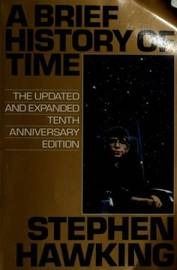
A Brief History of Time, by Stephen Hawking, is a popular book about the universe, from the Big Bang to black holes. Hawking was a Cambridge physicist who for thirty years held the Lucasian chair of mathematics, the post Isaac Newton once held. In 1963, at twenty one, he was diagnosed with a form of motor neurone disease and given about two years to live. He lived more than fifty more, and in the end spoke through a computer he controlled with a single muscle in his cheek. In 1982 he decided to write for a general audience, partly to pay for his children's education, and signed with Bantam, whose paperbacks were sold in drugstores, supermarkets and airports.
It is not a business book, and it is famous for another reason too. In 2014 the mathematician Jordan Ellenberg built a playful measure of how far people get in a book, based on the passages Kindle users highlight, and this one scored 6.6 percent. It has been called the most unread book of all time. Its central claim, useful far beyond physics, is that a theory is a model in our heads, and the best model explains the most with the fewest assumptions and makes predictions we can check. Its stories come from the history of science: Hubble, Einstein, black holes and a famous bet.
This is an independent written summary of the main ideas, in our own words, based on the Road MBA episode. We're not affiliated with the author or publisher, and nothing replaces reading the book.
The book opens with a scientist giving a public lecture on astronomy. An old lady stands up and says the world is really a flat plate on the back of a giant tortoise. When he asks what the tortoise stands on, she answers that it is turtles all the way down. Hawking's point: she has a picture of the universe, and so do we. The question is which picture is better.
A theory is a model in our heads. A good one explains a lot of what we see with only a few assumptions, and makes clear predictions we can check later. Ptolemy put the Earth in the center. Copernicus put the Sun there instead, and Newton's gravity made the new picture simpler. Each model won because it explained more with less.
In 1929 Edwin Hubble found that light from distant galaxies is shifted toward red, and the farther away a galaxy is, the bigger the shift. Galaxies are moving away from us and from each other. Run the film backwards and long ago everything was packed together: that beginning is the Big Bang. Einstein was so sure the universe was standing still that he added an extra term to his own equations to keep it still. Even the greatest mind of the century bent his model to fit what he already believed.
Following Einstein, time runs a little slower close to something heavy, like the Earth, and a little faster farther away. It is tiny but real. Atomic clocks have measured it, and the clocks on GPS satellites have to be corrected for it.
When a very big star collapses, gravity can crush it so hard that nothing escapes, not even light. Hawking compares its edge, the event horizon, to the words Dante put over the entrance to Hell: all hope abandon, ye who enter here. In 1974 he bet the American physicist Kip Thorne that an object called Cygnus X one was not a black hole. As the evidence piled up, Hawking conceded the bet.
This idea is Hawking's own, and the phrase is the title of one chapter. In 1974 he brought quantum physics, the physics of the very small, to the edge of a black hole, and the math said black holes should give off a faint glow and slowly lose mass. The smaller the black hole, the hotter it glows. Today it is called Hawking radiation. It is far too faint for our telescopes to detect, but most physicists accept it.
Relativity explains the very large and quantum physics the very small. Both work, but they don't fit together, and physicists are still looking for one theory that unites them. Hawking wrote that finding it would be the ultimate triumph of human reason, for then we would know the mind of God.
Someone warned Hawking that every equation in the book would cut his readers in half, so he kept exactly one: E equals m c squared. His editor at Bantam, Peter Guzzardi, kept asking questions again and again until he understood what Hawking meant. It took many months and many rewrites. Every team needs that person.
In 1985, with the draft still going back and forth with his editor, Hawking had a medical crisis. To save his life, doctors performed a tracheotomy, and he lost his voice for good. One of the first things he asked with his new computer voice was for his assistant to help him finish the book. Controlling the computer with a hand switch, he finished the final draft in the fall of 1987. The book came out in April 1988, stayed on the Sunday Times bestseller list in Britain for a record two hundred thirty seven weeks, and went on to sell more than ten million copies. A man who could no longer speak introduced millions of people to the Big Bang and black holes.
The one idea to keep: your plan is a model, not the truth. Say it simply, test it, and change it when the facts disagree. The Road MBA episode tells these stories in full.
Your first day is free, no card. Then all 30 for $29, one time.