
Written summary
Cal Newport · Day 12 of 30
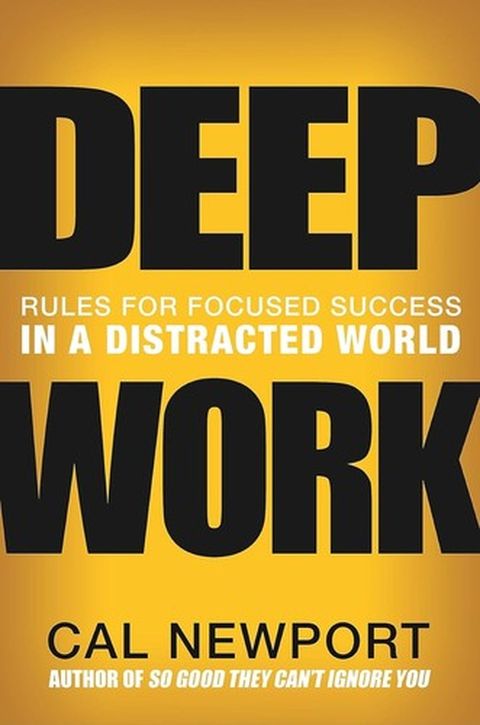
Deep Work, by Cal Newport, is a book about the value of focused, undistracted work and how to make room for it. Newport is a computer science professor who writes about attention and technology, and who also argues that most people don't need social media to build a great career. According to his own website, the book has sold more than a million and a half copies, and its title became a phrase people use at work.
His central claim is that the ability to work deeply is becoming rarer at the same time it is becoming more valuable, so the few people who build it will do very well. The book backs this with research on attention and with examples of people who protect their focus: the computer scientist Donald Knuth, the writer Walter Isaacson, and the psychologist Carl Jung, who built himself a stone tower by a quiet lake.
This is an independent written summary of the main ideas, in our own words, based on the Road MBA episode. We're not affiliated with the author or publisher, and nothing replaces reading the book.
Deep work is done with full concentration and no distractions, pushing your mind to its limit. It creates new value, improves your skills, and is hard for anyone else to copy. Shallow work is everything else: email, messages, quick meetings, small admin. It needs little thought, is often done while distracted, and almost anyone could do it.
Deep work is more valuable because the economy rewards people who can learn hard things quickly and produce work at a very high level, and both need long stretches of focus. It is rarer because the modern office is built around being always connected, always replying, always a little distracted. And being busy feels productive, even when it isn't.
A business researcher, Sophie Leroy, found that when you move from one task to another, part of your mind stays stuck on the first one, and you do worse on the second. Every quick glance at your inbox leaves a little of that residue behind, so you never get your full mind on the hard thing.
Willpower runs out, so build routines instead. Newport describes four styles of deep work:
Then add a ritual: where you'll work, for how long, and what rules apply, such as no internet. Sometimes a grand gesture, a big change of place or an investment of money or effort, tells your brain the task really matters. Pick one or two very important goals and keep a visible scoreboard of the deep hours you put into them.
Newport checks his email one last time, reviews his tasks and calendar, makes a plan for anything unfinished, then says a fixed phrase: shutdown complete. It tells your mind it's safe to let go. Capacity is limited too: by his reading of the research, a beginner manages about an hour of intense focus a day and experts around four. Working late mostly adds shallow hours.
Focus is like a muscle, and many of us train the opposite by grabbing the phone the moment we feel bored. Instead of taking the occasional break from distraction, take the occasional break from focus: decide in advance when you'll use the internet and stay off it the rest of the time. He also suggests productive meditation: while you walk, drive or shower, hold one hard problem in mind and bring your attention back each time it drifts.
Don't adopt a tool just because it has some benefit. Name the few things that matter most for your success and happiness, and keep a tool only if its good effects on those things clearly outweigh the bad. That is how Newport looks at social media.
Give every minute of your workday a job, in blocks on paper, and adjust the plan when things change. To spot shallow work, ask how long it would take to train a smart recent graduate to do the task. If not long, it should get only a limited part of your day. And make yourself a little harder to reach, so email doesn't run your schedule.
In 1923, Carl Jung had a busy practice in Zurich, patients until late at night, lectures and a full social life. Yet near the village of Bollingen he built a simple round stone tower where he went to think. He didn't leave the world. He kept his practice and his cafés, but for set periods he went to the tower, and much of his most important thinking happened there. That's the bimodal style in action. You don't need a tower, just a protected place and protected time, set in advance, where shallow work can't reach you.
The one idea to keep: focused, undistracted work is becoming rare and more valuable, so treat it as a skill. Choose your style, schedule deep blocks with a ritual, train your attention by resisting easy distraction, and shut work down cleanly at the end of the day.
Your first day is free, no card. Then all 30 for $29, one time.