
Written summary
Roger Fisher and William Ury · Day 8 of 30
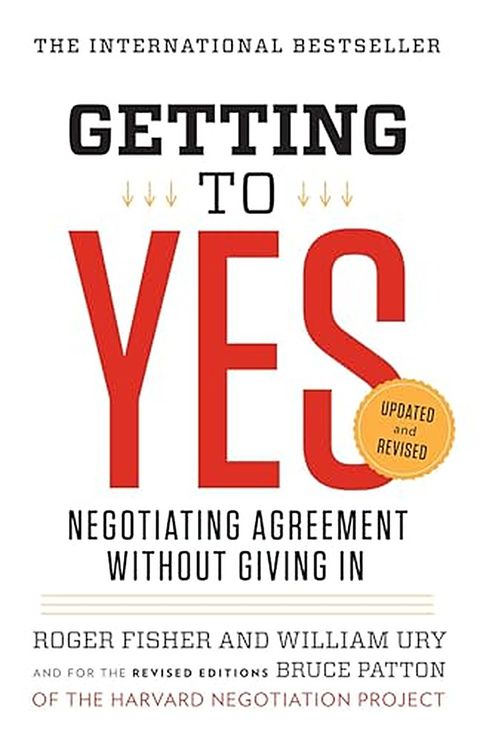
Getting to Yes, by Roger Fisher and William Ury, is a classic book on negotiation. Fisher taught law at Harvard and led the Harvard Negotiation Project, and Ury is an anthropologist who worked with him there. The book came out in 1981 and has been a best seller ever since. Its promise is in the subtitle: negotiating agreement without giving in. You don't have to choose between being the nice guy who gets walked over and the tough guy who wins the deal and loses the relationship. There is a third way.
The authors build their method from everyday disputes and high stakes diplomacy: two men arguing over a library window, a haggle over a brass dish, two sisters and one orange, nuclear test ban talks in the early 1960s, and the Camp David talks between Egypt and Israel in 1978. The method rests on four principles, plus a few tools for when the other side is stronger or doesn't play fair.
This is an independent written summary of the main ideas, in our own words, based on the Road MBA episode. We're not affiliated with the author or publisher, and nothing replaces reading the book.
Most people pick a position and defend it. In the book's example, a shopkeeper asks seventy five dollars for an old brass dish, the customer offers fifteen, and they inch toward each other. This produces worse agreements, because you split the difference between two arbitrary numbers. It is slow, because every concession is dragged out. And it damages the relationship by turning the talk into a contest of wills. In the early 1960s, the United States and the Soviet Union nearly agreed to ban nuclear tests, but the Soviets would allow three inspections a year and the Americans wanted at least seven. The talks collapsed over a number, and nobody had asked what an inspection actually meant.
Every negotiator is a human being first, with feelings, ego and a different view of the facts. When substance and relationship get tangled, every criticism of your offer feels like an attack. See the situation from their side, let them vent without reacting, give them a way to save face, and talk about how the problem affects you rather than what they did wrong. Be soft on the people and hard on the problem.
A position is what you say you want. An interest is why you want it. At Camp David, Egypt wanted all of the Sinai back, which Israel had held since 1967, and Israel wanted to keep part of it. No line on a map could satisfy both. Underneath, Israel's interest was security, no Egyptian tanks on its border, and Egypt's was sovereignty over land that had been Egyptian for thousands of years. The solution: the Sinai went back to Egypt, with large parts demilitarized. To find interests, ask why, and when they won't say, ask why not.
Two sisters argue over one orange and cut it in half. One squeezes her half for juice and throws away the peel. The other throws away the fruit and uses her peel for a cake. Each could have had all she wanted. Separate inventing from deciding: brainstorm many options with no judging, look for things cheap for you and valuable for them, and only then choose.
At Camp David, instead of each side pushing its own proposal, the American team wrote one draft, showed it to both sides, asked for criticism rather than concessions, and rewrote it. After thirteen days and around twenty three drafts, both leaders were willing to sign. Nobody gave in; everyone improved the same piece of paper.
When interests clash, agree on a fair standard instead of testing who is more stubborn: market value, an expert's opinion, what a court would decide, what was paid last time. A man whose car is totaled asks his insurer how they calculated their number and brings ads for the same model and year. The talk becomes about evidence, not willpower. It's the old rule for two kids sharing a cake: one cuts, the other chooses.
Your best alternative to a negotiated agreement is what you will do if this deal doesn't happen: another job offer, another supplier, another buyer. It is the real measure of your power because it tells you when to walk away. The authors warn against fixing a bottom line too early, which can make you accept a bad deal or reject a good one. A strong BATNA lets you stay flexible.
When the other side attacks, don't push back. Step aside and redirect the energy toward the problem. If they attack your idea, ask for their criticism and advice. If they attack you, treat it as an attack on the problem. Use questions instead of statements, because statements create resistance and questions create answers. Sometimes the strongest move is to ask, then stay silent.
Two men argue in a library: one wants the window open, the other closed. Just a crack? Halfway? The librarian asks the first man why. Fresh air. She asks the second. To avoid the draft. So she opens a window in the next room. Fresh air, no draft. She never argued about the position. She asked about the interest.
The one idea to keep: don't argue over positions, ask about interests. Behind every demand there's a reason, and once you know it you can usually find an option that works for both sides.
Your first day is free, no card. Then all 30 for $29, one time.