
Written summary
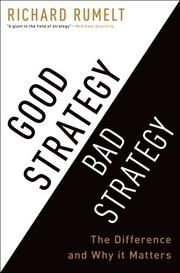
Richard Rumelt · Day 15 of 30
Good Strategy Bad Strategy, by Richard Rumelt, is a book about what a real strategy is and how to tell it apart from the slogans and wish lists that usually carry the name. Rumelt started out as an engineer, working on systems design at the Jet Propulsion Laboratory in the 1960s, then spent decades as a business school professor studying and teaching strategy. He was one of the founding members of the Strategic Management Society. The book came out in 2011 and was one of six finalists for the Financial Times and Goldman Sachs Business Book of the Year.
His central claim is a little uncomfortable: most of what people call strategy is not strategy at all. A real strategy is a way through a difficulty, a response to a challenge. If a plan doesn't name the problem and say what you'll actually do about it, it's a wish. The book draws on companies and wars: a retail bank, a school district, Desert Storm, Hannibal at Cannae, the moon landing, a small corner grocery, and Apple when Steve Jobs came back in 1997.
This is an independent written summary of the main ideas, in our own words, based on the Road MBA episode. We're not affiliated with the author or publisher, and nothing replaces reading the book.
Big words that sound smart and say nothing. A large retail bank's internal notes said its fundamental strategy was customer centric intermediation. Intermediation just means taking deposits and lending the money out. In other words, they were a bank, and nothing in their products was more customer centric than anyone else's.
If you can't say what the real obstacle is, you can't judge a strategy or improve it. You're just choosing activities. And a boss who announces twenty percent growth a year with a twenty percent margin has stated a desire, not a plan. It doesn't tell anyone what to do differently on Monday morning.
Rumelt calls one kind the dog's dinner: everything everyone wanted, thrown into one document and labeled a strategic plan. The other is the blue sky objective, a goal just as hard as the original problem, like the school district whose plan asked for transformational leadership. Nobody knew how to produce that, so it gave no guidance.
Good strategy means choosing, and choosing means saying no to people, ideas and projects someone loves. A list that keeps everyone happy is easier. In Desert Storm, the plan itself was a classic military move. What surprised people was how tightly it was coordinated. Many groups wanted a bigger role, and saying yes to each could have put the whole thing at risk. Focus means saying no most of the time.
Stephanie owns a corner grocery near a university and has a hundred questions: lower prices or organic produce, longer hours, a second checkout, parking, ads, even the ceiling color.
In September 1997 Apple was about two months from bankruptcy. The diagnosis: a small, niche player in a brutal market, running out of money. The guiding policy: shrink to a core that can survive. The actions: fifteen desktop models became one, the portables became one laptop, printers and other add ons went, and five of six national retailers were dropped. Manufacturing moved almost entirely to Taiwan, which helped cut inventory by more than eighty percent, a web store sold straight to customers, and Jobs talked Microsoft into investing one hundred fifty million dollars. Every action pointed the same way.
Put your strength against the one point where it matters most. The oldest example in the book is Hannibal at Cannae, where a smart move of his troops cancelled out the bigger Roman army.
A good objective is close enough that people can work on it. Planning the moon landing, nobody knew what the moon's surface was really like, so engineers designing the lunar vehicles were stuck. Phyllis Buwalda, who led future mission studies at the Jet Propulsion Laboratory, wrote down a working model of the surface, close to the desert of the American Southwest. That gave the engineers a problem they could solve. A leader's job is to absorb much of the mess and hand the team a simpler problem.
In the summer of 1998, Rumelt himself told Jobs the turnaround was impressive, but everything known about the PC business said Apple could not grow past a small niche. So what was the long term strategy? Jobs smiled and said he was going to wait for the next big thing. It sounds like no strategy, but it was one: survive, stay lean, keep your strength, and be ready to move hard when the opening comes.
The one idea to keep: a goal is not a strategy; name the real problem first, pick one way through it, and say no to everything that doesn't fit.
Your first day is free, no card. Then all 30 for $29, one time.