
Written summary
Jared Diamond · Day 27 of 30
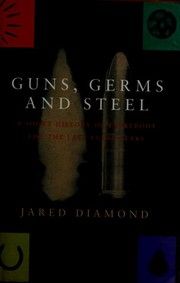
Guns, Germs, and Steel, by Jared Diamond, tells the story of the whole planet over thirteen thousand years and asks why some societies came to dominate others. Diamond was born in Boston in 1937. He started as a physiologist, began a second career studying birds in New Guinea in his twenties, and later a third, in geography, at UCLA, where he taught until 2024. The book came out in 1997 and won the Pulitzer Prize the next year. It is history, geography and biology, not a business book, but very practical people loved it. Charlie Munger, Warren Buffett's partner, called it one of the best books of its kind, and business people wrote to Diamond asking what it meant for their companies.
It starts with a question from Yali, a local politician in New Guinea, where people called the goods outsiders brought in cargo. Why, he asked, had white people developed so much cargo while his people had little of their own? Diamond first rules out that some people are smarter: the New Guineans he worked with were every bit as intelligent, and often more resourceful. His central claim is that the differences came from the environments people started in, not from the people themselves. The book's cases range from the Inca emperor's capture in Peru to Tasmania, Ming China's fleets and Columbus.
This is an independent written summary of the main ideas, in our own words, based on the Road MBA episode. We're not affiliated with the author or publisher, and nothing replaces reading the book.
About thirteen thousand years ago, at the end of the last Ice Age, everyone on every continent hunted and gathered. Then, in a few places, people started farming. Farming meant extra food, then more people, villages and cities. It also meant some people no longer had to look for food all day. They could be soldiers, metal workers, scribes and rulers. That is where writing, steel and organized states come from.
You can only farm what nature gives you. The Fertile Crescent, in the Middle East, had an unusual set of wild plants that were easy to turn into crops. Animals were even more uneven: Diamond counts only fourteen big species domesticated before the twentieth century, and the wild ancestors of thirteen lived only in Eurasia. Borrowing from Tolstoy, he says domesticable animals are all alike, while every animal that can't be domesticated fails in its own way: too dangerous, too panicky, too slow to grow, or unwilling to breed in captivity.
Eurasia runs mostly east to west, so a crop could travel thousands of kilometers along the same latitude, with similar seasons and days. Africa and the Americas run north to south, so crops and animals had to cross deserts, jungles and very different climates, and many never made it.
Living close to farm animals in crowded towns, Eurasians caught diseases like smallpox and measles, and over generations built some resistance. When Europeans reached the Americas, the diseases went with them. It is believed most of the native population of the Americas was killed by disease, not swords.
When the seas rose about ten thousand years ago, Tasmania was cut off from mainland Australia. A few thousand people lived there with no outside contact until Europeans arrived in 1642. By then they lacked things the mainland had, like boomerangs, and had lost things they once had. Bone tools disappear from the record about three thousand years ago, and bone tools mean needles and warm clothes, on an island where it snows. Most groups get most new ideas from outside. A team that stops looking outside doesn't stand still. It goes backwards.
Diamond calls it optimal fragmentation. Between 1405 and 1432, China sent seven huge fleets as far as Africa. Then a new emperor decided ships were a waste of money, and in a unified China that one decision ended it. In a Europe of competing kingdoms, Columbus was turned down in Italy, France, Portugal, by two Spanish dukes and by Spain's king and queen, and in Diamond's telling got three small ships on the seventh try. For companies, Diamond pictures many small teams with real freedom that compete but talk openly: not one boss who can say no to everything, and not a hundred groups that never share.
Diamond separates proximate causes, the ones you can see, like guns, germs and steel, from ultimate causes such as crops, animals and geography. In business we usually stop at the first answer: we lost the client because the price was too high. The next question, why was our price too high, is where the real answer usually lives.
The book has fierce critics. Many historians, anthropologists and geographers say it gives geography too much power and too little room for people's choices and cultures. Economists like Daron Acemoglu argue that institutions matter more than geography.
On November 16, 1532, in the town square of Cajamarca, Peru, Francisco Pizarro hid with about a hundred and seventy Spanish soldiers. The Inca emperor Atahualpa, ruler of the largest and most advanced state in the Americas, had an army sources put at around eighty thousand. He walked into the square with thousands of mostly unarmed attendants, and by sunset he was a prisoner and thousands of his people were dead. Part of the reason was steel, armor and horses, and a smallpox epidemic that had already killed the previous emperor and his heir and set off a civil war. But Diamond adds writing. Pizarro knew the written accounts of Columbus and of Cortés in Mexico. Atahualpa only had what one envoy told him after watching the Spaniards for a couple of days. One side learned from other people's experience. The other was alone.
The one idea to keep: don't build your own Tasmania: a group that stops learning from outside doesn't just fall behind, it forgets what it knew. The Road MBA episode tells these stories in full.
Your first day is free, no card. Then all 30 for $29, one time.