
Written summary
Dale Carnegie · Day 3 of 30
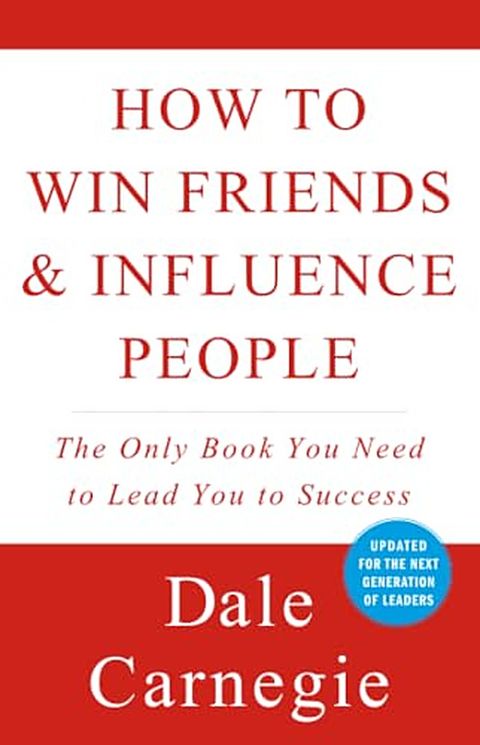
How to Win Friends and Influence People, by Dale Carnegie, is a book about dealing with people. Carnegie grew up poor, on a farm in Missouri. In 1912 he started teaching public speaking to adults at night in New York, and he soon noticed that what his students really needed was something else: how to get along with others. The book came out of those classes in 1936 and has sold more than thirty million copies.
Its central idea fits in two sentences. People are not driven by logic. They are driven by feelings, by pride, and by a hunger to feel important. Carnegie makes the case with stories from history and business: Abraham Lincoln after Gettysburg, a gunman trapped by New York police, a test pilot whose engines died, the steel executive Charles Schwab, and a dinner party where Carnegie barely said a word.
This is an independent written summary of the main ideas, in our own words, based on the Road MBA episode. We're not affiliated with the author or publisher, and nothing replaces reading the book.
In New York in 1931, a gunman called Two Gun Crowley was trapped in an apartment by police. He had shot an officer who simply asked for his license, yet while the bullets flew he wrote a note saying that under his coat beat a tired but kind heart that would never hurt anyone. Al Capone, Carnegie adds, saw himself as a misunderstood public benefactor. If killers don't blame themselves, almost nobody thinks they are the villain. Criticism doesn't change people. They defend themselves and resent you. Carnegie compares it to a homing pigeon: it always flies back to you.
The test pilot Bob Hoover was flying home from an air show in San Diego when both engines died. He landed, but the plane was badly damaged, and he learned the old propeller plane had been filled with jet fuel instead of gasoline. He found the young mechanic, who was in tears. Hoover didn't shout. He put his arm around him and asked him to service his plane the next day, to show he was sure it would never happen again.
Carnegie cites the philosopher John Dewey: the deepest urge in human nature is the desire to be important. Charles Schwab, reported to be one of the first people in America paid a million dollars a year to run a company, told Carnegie many of his men knew more about steel than he did. He was paid for how he handled people: generous with praise, very slow to find fault. Flattery is cheap and fake, and people can smell it. Appreciation is honest and specific.
Carnegie loved strawberries and cream, but when he went fishing he used worms, because that is what the fish want. People care about what they want. So before asking for anything, ask how you can make this person want to do it. Carnegie quotes Henry Ford: the secret of success is the ability to see things from the other person's point of view.
At a dinner party in New York, Carnegie sat next to a well known botanist and spent the whole evening asking about plants, gardens, even potatoes. He barely spoke about himself. At the end of the night, the botanist told the host Carnegie was a most interesting conversationalist. All he had done was listen.
A person's name is, to that person, the most important sound in any language. Andrew Carnegie, competing with George Pullman for a railroad sleeping car contract while both were losing money, proposed joining forces. Pullman hesitated, then asked what the new company would be called. The Pullman Palace Car Company, of course. The deal was done. Jim Farley, who left school to work in a brickyard after his father died, learned the full name and a few facts about everyone he met. He told Carnegie he could call fifty thousand people by their first names, and the habit helped him run Franklin Roosevelt's winning campaign in 1932.
At a banquet in London, a man said a line came from the Bible. Carnegie knew it was Shakespeare and said so. His friend Frank Gammond, who had studied Shakespeare for years, kicked him under the table and said Dale was wrong. On the way home he admitted it was from Hamlet, and asked why prove a man wrong at a party. If you lose an argument, you lose. If you win, you still lose, because the other person feels smaller. Show respect for their opinion, never say "you're wrong," and when you are wrong, admit it fast.
One of Schwab's steel mills was always behind. He asked the day shift how many heats of steel they had made. Six. He wrote a big six on the floor in chalk and walked away. The night shift left a seven. The next evening the day shift left a ten. Soon the mill was the best in the plant, and no one had been criticized.
In July 1863, after Gettysburg, Robert E. Lee's army was trapped by the flooded Potomac. Lincoln ordered General George Meade to attack. Meade waited, the river went down, and Lee escaped. Lincoln wrote Meade a brutal letter. Meade never read it, because Lincoln never sent it; it was found among his papers after his death. Lincoln had learned young. In 1842 he mocked a politician named James Shields in an anonymous newspaper letter, and Shields challenged him to a duel. The two met on a sandbar in the Mississippi with cavalry swords before their seconds stopped it. Carnegie says Lincoln never again wrote a letter insulting anyone.
The one idea to keep: people move for their feelings and pride, not your logic, so make them feel important. The Road MBA episode tells these stories in about ten minutes.
Your first day is free, no card. Then all 30 for $29, one time.