
Written summary
Eliyahu M. Goldratt · Day 9 of 30
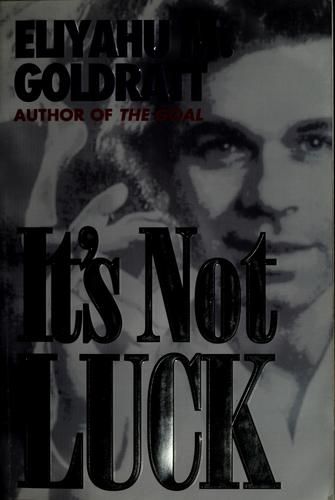
It's Not Luck, by Eliyahu M. Goldratt, is a business novel. Goldratt was an Israeli physicist who became one of the best known business thinkers of his time. He created the Theory of Constraints, and instead of writing textbooks, he told his ideas as novels. The first, The Goal, follows a plant manager named Alex Rogo who saves his factory. It's Not Luck came out in 1994 and is the sequel. Alex now runs three companies inside a big manufacturer called UniCo: a printing company, a cosmetics company and a company that sells pressure steam equipment.
Just as Alex pulls the three companies out of the hole, the board decides to sell them because UniCo needs money. If he improves them, they get sold and new owners will likely replace him. If he fails, they get closed. His only way out is to think more clearly than everyone around him, with logic rather than luck. The book's central claim is that clear thinking tools can dissolve conflicts and fix root causes, and it shows them at work in three companies and one family kitchen.
This is an independent written summary of the main ideas, in our own words, based on the Road MBA episode. We're not affiliated with the author or publisher, and nothing replaces reading the book.
Goldratt starts from a bold belief. A conflict is not proof that one side has to lose. It is a sign that somebody, often both people, is holding a hidden assumption that isn't true. Find that assumption, and the conflict can disappear like a cloud. He calls the tool the evaporating cloud.
The cloud is a small diagram with five boxes. Then you read the arrows out loud: to reach our goal, I need this; to get this need met, I want that. Every arrow hides a quiet "because". Your job is to find the one that isn't true and break it. You don't split the difference. You look for a third option that gives both sides what they really need.
Most problems you see every day are not separate problems. They are symptoms. List what bothers you, ask step by step what causes what, and you usually find a few causes underneath that explain most of the list. Fix those, and many symptoms go away together. Goldratt draws this as a map of cause and effect. The question to keep asking: is this the problem, or a symptom of something deeper?
Alex's team applies the same pattern to each company. Don't rush to build a better product. Look at the customer's real problems, find what's causing them, and change the offer. This is where the novel becomes a lesson in marketing.
Pete prints candy wrappers and keeps losing big orders to competitors with bigger, faster presses. New machines aren't an option. So he asks why customers order such huge quantities. The low price per wrapper. But promotions, ingredients and labeling rules change, and much of a six month order ends up as waste. Pete offers smaller orders in small batches, at a price that beats the big order once you count what the customer would have thrown away. Customers hold less stock and take less risk, and Pete fills presses that were sitting idle.
Bob's customers are stores with three problems: they run out of products people ask for, get stuck with old products they must discount, and are short on cash. Part of the cause is that discounts reward big orders, so stores buy months of stock at once. Bob's team ties the discount to yearly volume, not one order, refills shelves daily from Bob's warehouses, and supplies on consignment so stores pay only when an item sells. Stores love it and end up paying sooner, because paying for what sold is how they get new stock.
In Stacey's industry, equipment is sold cheap and the money is made later on high margin spare parts, because the customer is locked in. Her team flips it. The customer doesn't want to own a boiler; the customer wants reliable steam. So they run the equipment, keep the spare parts, and charge a monthly fee plus a fee for the steam used. By the end, logic wins: two companies are sold, UniCo keeps the third because it has become too profitable to let go, and Alex is set to take the top job.
Alex's teenage daughter Sharon wants to go to a party. He says yes, but home by ten. She says nobody leaves that early and she'd look like a little kid. His wife, Julie, tells him to stop giving orders and use the cloud. His need: Sharon is safe. Hers: to be treated like the others. The shared goal: a good night and a good relationship. Why ten o'clock? Because coming home late is dangerous. What exactly is dangerous? The ride home, since her friends are too young to drive. Sharon finds the answer herself: "Dad, can you drive us home?" Nobody gave in. They broke an assumption.
The one idea to keep: when two sides want opposite things, don't fight over the wants or split the difference. Find the need behind each, find the hidden assumption that links them, and break it.
Your first day is free, no card. Then all 30 for $29, one time.