
Written summary
Chip Heath and Dan Heath · Day 16 of 30
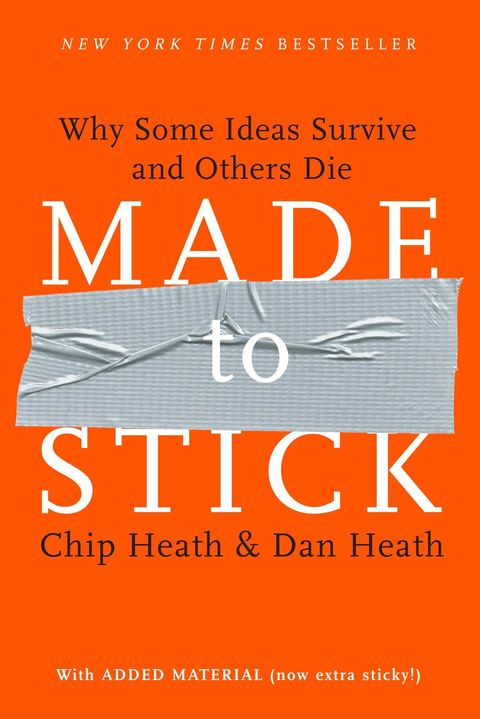
Made to Stick, by Chip Heath and Dan Heath, is a book about why some ideas survive while others die, even when the dying ones are more important. Chip Heath teaches at Stanford, and his brother Dan worked on teaching and training. The book came out in 2007.
Their answer starts with a villain, the curse of knowledge, and then offers six principles that help an idea stick: simple, unexpected, concrete, credible, emotional, and stories. Together they almost spell the word success. The book proves each one with memorable cases: Southwest Airlines, the army, Nordstrom, a Boeing jet, a doctor who drank bacteria, a hunger charity, a World Bank manager, and a famous press conference about movie theater popcorn.
This is an independent written summary of the main ideas, in our own words, based on the Road MBA episode. We're not affiliated with the author or publisher, and nothing replaces reading the book.
In a Stanford study by a graduate student, Elizabeth Newton, people tapped the rhythm of a well known song, like Happy Birthday, on a table, and a listener had to guess it. Tappers predicted listeners would get about half. Out of a hundred and twenty songs, listeners got three. The tappers heard the melody in their heads; the listeners heard knocking. Once you know something, it's very hard to imagine not knowing it. That's the trap for every expert, manager and presenter.
Simple doesn't mean dumbed down. It means finding the core. Southwest Airlines, the book says, ran on one line from its leader, Herb Kelleher: we are the low fare airline. When someone suggested adding a chicken Caesar salad to flights, the question answered itself. One sentence let thousands of people make the same decision without asking. The army learned something similar. Detailed battle plans fall apart once fighting starts, so officers add commander's intent: the one outcome that matters, written so plainly that a soldier who loses contact with headquarters still knows what to do. The test: if people remember only one thing, which should it be?
To get attention, break a pattern. Nordstrom made its idea of service stick with stories like an employee who ironed a customer's new shirt for a meeting that afternoon, and another who cheerfully gift wrapped something bought at a rival store. To keep attention, open a gap. Drawing on the psychologist George Loewenstein, the book describes curiosity as the feeling of a gap in our knowledge. That's why a good talk opens with a question instead of an answer.
When Boeing designed the seven twenty seven in the 1960s, the goal was a plane that could seat a hundred and thirty one passengers, fly nonstop from Miami to New York, and land on a particular short runway at LaGuardia. Every engineer knew what success looked like. Abstract goals get debated; concrete goals get built. The brothers call this the Velcro theory of memory: the more hooks an idea has, a picture, a sound, a feeling, the more places it can catch in your mind.
In the early 1980s, the Australian doctor Barry Marshall was sure most stomach ulcers came from a bacterium, not stress. Other doctors laughed. So he drank water full of the bacteria, got sick with the early stages of the disease, and cured himself with antibiotics. Years later he shared a Nobel Prize. There's also the Sinatra test: one example so strong it settles the question. An Indian delivery company, the book says, won clients by pointing to one job, delivering a Harry Potter book across India for release day without a single early copy leaking.
In a study the book describes, some people read statistics about millions of hungry children in Africa, and others read about one girl, Rokia, seven years old, from Mali. The Rokia group gave more than twice as much. People who got Rokia's story plus the statistics gave less than for Rokia alone. The numbers switched on the calculating mind and switched off the heart.
When you hear how someone handled a problem, you rehearse handling it yourself. A story carries the other principles at once. At the World Bank in the 1990s, Stephen Denning was trying to convince the organization to share what it knew, and charts didn't work. So he told a true story: a health worker in a small town in Zambia needed to know how to treat malaria and found the answer on a website of the United States Centers for Disease Control. Then he asked people to imagine the World Bank's knowledge being that easy to find. The idea took hold.
In 1994, the Center for Science in the Public Interest had popcorn tested. Most theaters popped it in coconut oil, and a medium bag carried thirty seven grams of saturated fat, against a recommended daily limit of about twenty. Announced in grams, almost nobody would care. So Art Silverman said that a medium bag had more of the bad fat than a bacon and eggs breakfast, a Big Mac and fries for lunch, and a steak dinner with all the trimmings, put together, and showed all that food on a table. Simple, unexpected, concrete and emotional at once. Popcorn sales dropped, and the big theater chains announced they would stop using coconut oil.
The one idea to keep: ideas stick when they're simple, unexpected, concrete, credible, emotional, and told as stories. You don't need all six. Find the core, and give it one picture people can see.
Your first day is free, no card. Then all 30 for $29, one time.