
Written summary
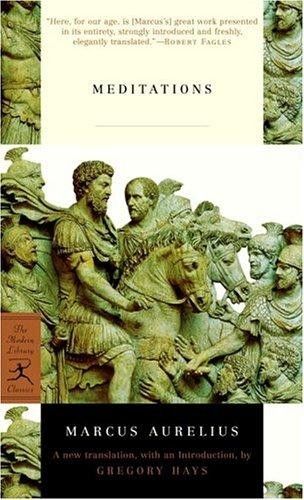
Marcus Aurelius · Day 30 of 30
Meditations, by Marcus Aurelius, is barely a book at all. It is a private notebook: twelve short books of notes, written in Greek and addressed to nobody but the author himself, with no plot and no clear order. It probably had no title, and one old title is simply To himself. Marcus Aurelius was emperor of Rome from 161 to 180. When the job came to him, he refused to take it alone and insisted that his adoptive brother, Lucius Verus, share equal power. His reign was hard: a long plague, years of war along the Danube, and in 175 the revolt of one of his top generals, Avidius Cassius.
As far as we know, he never meant anyone else to see these notes. That is what makes them useful: they show the most powerful man in the world coaching himself, day after day, on a few ideas he kept coming back to. Its central claim is that we can't choose what the day brings, but we can always choose our judgment about it and our next action. It is not a business book, yet it carries some of the most practical advice there is for a hard day at work. Even he had an inbox: as a young man in training, he complained to his teacher of being out of breath from dictating nearly thirty letters.
This is an independent written summary of the main ideas, in our own words, based on the Road MBA episode. We're not affiliated with the author or publisher, and nothing replaces reading the book.
The notebook opens with a thank you list. From his grandfather, good character and control of his temper. From his teacher Rusticus, the teachings of Epictetus, the Stoic philosopher. Page after page, he names people and what he learned from each one. Historians have noticed one name he leaves out: Hadrian, the emperor who arranged for him to rule one day.
Book two opens, in one old translation, with a morning reminder: today I shall meet the busybody, the ungrateful, the arrogant, the deceitful, the envious. Not to get angry in advance, but to be ready. They act that way, he says, because they don't know any better. Then he reminds himself that people are made to work together, like feet, hands, eyelids, or the upper and lower rows of teeth. Working against each other goes against our nature.
If something outside you causes pain, he writes, it isn't the thing that disturbs you but your judgment about it, and you have the power to wipe that judgment out right now. He trains himself not to add to the facts. Someone spoke badly of you: that is the report. The report did not say you were harmed.
Stoic philosophy was the original inspiration for cognitive therapy. The original cognitive therapy manual for depression, by Aaron Beck and colleagues, traces its roots back to the Stoics.
He writes that the mind turns every obstacle to its action into an aid. What blocks the road helps you along the road. Ryan Holiday took the title The Obstacle Is the Way from that very line.
Don't act as if you were going to live ten thousand years, he writes. Death hangs over you, so while you live and while it is in your power, be good. He reminds himself that Alexander the Great and his stable hand ended up in the same place.
Take care that you are not made into a Caesar, he warns himself, that you are not dyed with this dye. The emperor of Rome was writing a warning to himself about power.
If anyone can show me I'm thinking or acting wrongly, he writes, I'll gladly change. Stoicism isn't about having no feelings. It is a practice, not a trick, and the notebook shows him practicing it every day.
Picture an army camp on the Danube frontier, more than eighteen hundred years ago, during years of war and plague. The emperor has generals waiting for orders and letters waiting for answers, yet he takes time for short notes to himself. Marcus died in 180, and for centuries almost nobody mentions them. The first clear mention comes around 900, more than seven hundred years later, when a bishop, Arethas of Caesarea, sent a copy to an archbishop. He wrote that he had an old copy of the emperor Marcus' most profitable book, so old it was falling to pieces, so he had it copied. The first printed edition came out in Switzerland in 1558 or 1559, from a manuscript that has since been lost. A diary never meant for anyone survived because, again and again, someone thought it was worth copying by hand.
The one idea to keep: you can't choose what the day brings. You can always choose your judgment about it, and your next action. The Road MBA episode tells these stories in full.
Your first day is free, no card. Then all 30 for $29, one time.