
Written summary
Chris Voss (with Tahl Raz) · Day 7 of 30
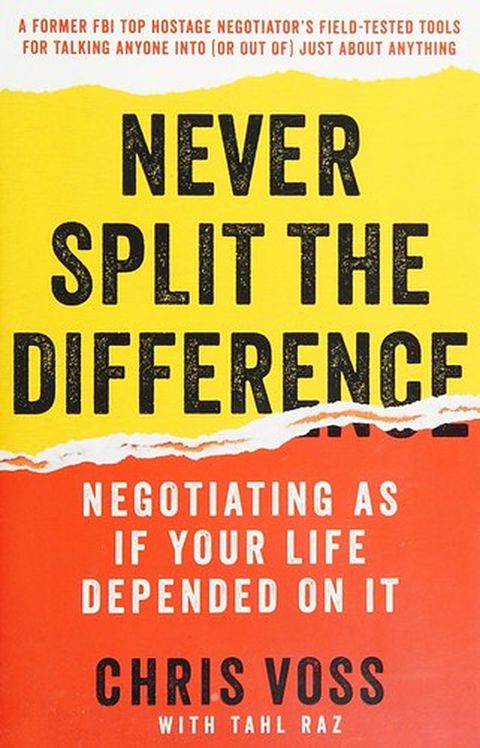
Never Split the Difference, by Chris Voss with Tahl Raz, is a negotiation book from a man who spent more than two decades in the FBI and became its lead international kidnapping negotiator. Its central claim is simple and a little uncomfortable. We like to think negotiation is logic: facts on the table, and the best argument wins. Voss says that is not how people work. People decide with their emotions first and explain it with logic later. So the best negotiators are not the best debaters. They are the best listeners.
The book is built on real cases: a 1993 bank robbery in Brooklyn, a kidnapping in the southern Philippines, and a role play at Harvard Law School where a professor played a kidnapper. Each one teaches a tool you can use in an ordinary conversation, with a client, a supplier, a boss or a colleague.
This is an independent written summary of the main ideas, in our own words, based on the Road MBA episode. We're not affiliated with the author or publisher, and nothing replaces reading the book.
A mirror means repeating the last one to three words the other person just said, as a gentle question, and then staying quiet. Someone tells you, "We just don't have the budget this quarter." You answer, "The budget this quarter?" Almost always, they keep talking and tell you what is really going on. Voss cites a study by the psychologist Richard Wiseman: waiters who simply repeated a customer's order back got much bigger tips than waiters who used praise and positive words. People trust what sounds like them.
How you say it matters as much as what you say. Voss describes a low, slow, calm voice that says everything is under control. When one person slows down, the other person slows down too. Panic is contagious. So is calm.
Instead of pretending the other person's emotions aren't there, you name them out loud. "It seems like you're frustrated with how this went." "It sounds like timing is the real problem." A label never starts with "I", and it is followed by silence. Naming a fear takes away much of its power. Naming something good makes it stronger.
Before a hard conversation, list every negative thing the other person might be thinking about you, and say it first. "You're probably going to think this is unfair." "You may feel I'm asking for too much." Once the worst is said out loud, it usually shrinks, and the other person often answers, "No, it's not that bad."
A yes you squeeze out of someone is often fake: they say it to get rid of you. No makes people feel safe and gives them control. So instead of asking "Do you have a few minutes to talk?", Voss asks "Is now a bad time?" People relax when they are allowed to say no, and from that safe place the real conversation can begin.
In the summer of 2000, a militant group in the southern Philippines kidnapped Jeffrey Schilling, a 24 year old from California. Its leader, Abu Sabaya, demanded ten million dollars and would not move for months. So the officer on the phone stopped arguing. He listened, mirrored, labeled, and then summarized the whole story the way Sabaya saw it. After a long silence, Sabaya said, "That's right," and never mentioned the money again. Months later, Schilling escaped, was rescued and went home safe. "You're right" is what people say to make you stop talking. "That's right" is what they say when they truly feel understood, and that is when things start to move.
Questions that start with how or what don't attack. They invite the other person to solve your problem, and give them the feeling of being in control while you steer. "How am I supposed to do that?" "What are we trying to solve here?" "How can we make this work for both of us?" At Harvard, when a professor played a kidnapper demanding one million dollars for Voss's son, Voss kept asking how he was supposed to do that, and the expert ended up doing the work for him. Voss also tells of a consultant whose client would not pay an overdue bill. She asked the same question and was paid within two days.
Meeting halfway feels fair, but it often means nobody gets what they need. Voss compares it to wearing one black shoe and one brown shoe. For hard bargaining he teaches a system he learned from a former CIA officer, Mike Ackerman. Set your target, open at 65 percent of it, then move up in shrinking steps to 85, 95 and 100 percent, using empathy and different ways of saying no in between. Make the final number precise and odd, like 4,751 instead of 5,000: a round number sounds like a guess, a precise one sounds like you did the math. Then add something small that isn't money, to show you have reached your limit.
In 1993, two masked men took hostages in a Chase Manhattan bank in Brooklyn. On the phone, the lead robber, Chris Watts, was calm and confusing and claimed he was not in charge. In passing, he complained that the police had chased his driver away. Voss's team simply repeated it: "We chased your driver away?" Watts kept talking, revealed an accomplice the FBI did not know about, and the getaway driver was caught. Voss admits his own mistake that day too: asking Watts directly, "Are you Chris Watts?" got an easy denial. The mirror worked. The accusation didn't. The hostages came out, Watts surrendered, and nobody was killed.
The one idea to keep: don't split the difference. Ask how, and listen to the answer. The Road MBA episode tells these stories in full, in about ten minutes.
Your first day is free, no card. Then all 30 for $29, one time.