
Written summary
Peter F. Drucker · Day 17 of 30
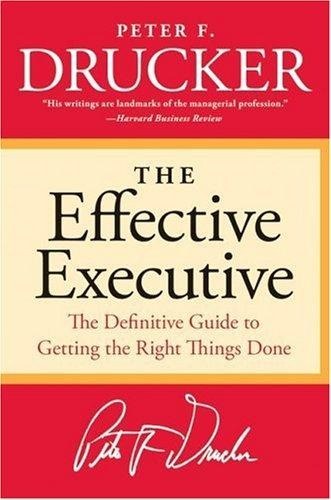
The Effective Executive, by Peter F. Drucker, is a short classic on how people who work with their minds get the right things done. Drucker was born in Vienna in 1909, earned a doctorate in Frankfurt, and left Germany for England within two days when the Nazis took over in 1933. He later moved to the United States, spent two years studying General Motors from the inside, and taught management at New York University and in Claremont, California. He wrote thirty nine books, received the Presidential Medal of Freedom in 2002, and died in 2005, at ninety five.
The book came out in 1967, and its central claim is hopeful: effectiveness can be learned. Drucker says he never met an executive who was born effective. And by executive he means anyone whose work and judgment shape the results of the team or company: a manager, but also an engineer, a nurse, a designer or a founder. He boils it down to five habits of the mind, told through stories of a company chairman, a bank president, Harry Hopkins, Abraham Lincoln and Alfred Sloan.
This is an independent written summary of the main ideas, in our own words, based on the Road MBA episode. We're not affiliated with the author or publisher, and nothing replaces reading the book.
Time is the scarcest resource you have. You can raise money and hire people, but you can't rent, buy or borrow one more hour. And memory lies about it. So effective people do three things:
Important work, like thinking through a plan or really talking with someone on your team, needs a long stretch. Fifteen minutes here and ten there add up to hours on paper and nothing in practice. Drucker met a bank president once a month for two years, always for exactly an hour and a half, on one topic only. The president explained that his attention lasted about ninety minutes: longer and he repeated himself, shorter and nothing important could be tackled.
Harry Hopkins, President Roosevelt's closest adviser in the Second World War, was so sick he could only work a few hours every other day. So he cut out everything except what truly mattered. Winston Churchill called him Lord Heart of the Matter, and Drucker says he got more done than anyone else in wartime Washington.
Most people look down at their effort: how busy they are, what they're owed, how much authority they should have. The effective person looks up and out and asks: what can I contribute that will really change the results here? What results are expected of me? That one question changes how you run a meeting, what goes in a report, and even what you ask from your boss.
President Lincoln was told that his new top general, Ulysses Grant, drank too much. He answered that if he knew Grant's brand, he'd send a barrel or so to some other generals. Before Grant, Lincoln had picked generals mainly for having no big weaknesses, and the North went three years without real progress. Grant had one proven strength: he could plan and win battles. Don't hire or promote for the absence of weakness. Ask what someone can do exceptionally well and build the job around it, for yourself too.
If effectiveness has one secret, Drucker says, this is it. There are always more good things to do than time to do them, so the hard part is choosing what you will not do, and sticking to it. His test for everything already under way: if we weren't doing this already, would we start it now? If the answer isn't a clear yes, drop it or cut it back hard, and move your best people to what comes next.
Drucker's surprising rule: don't make an important decision unless there's disagreement. Alfred Sloan, who ran General Motors for decades, once saw everyone at a meeting agree on a decision. He proposed postponing it to the next meeting, to give everyone time to develop disagreement and understand what the decision was really about. A room that agrees at once usually hasn't looked hard enough. Hear the strongest opposing views, and make a few big decisions well instead of many small ones fast.
A busy, successful company chairman was certain he split his time into three equal parts: his senior people, his most important customers, and work for the community. Drucker asked him to have his secretary write down what he actually did, hour by hour, for six weeks. The record showed almost no time in any of the three. He was acting as a kind of dispatcher, tracking orders from customers he knew personally and calling the factory about them, though most were going through fine and his calls could only slow them down. He didn't believe the first record. It took two or three more time logs before he accepted it. With your time, trust the record, not your memory.
The one idea to keep: effectiveness can be learned, and it starts with your time. Know where your hours really go, then spend the best of them on the one contribution only you can make.
Your first day is free, no card. Then all 30 for $29, one time.