
Written summary
Clayton Christensen · Day 24 of 30
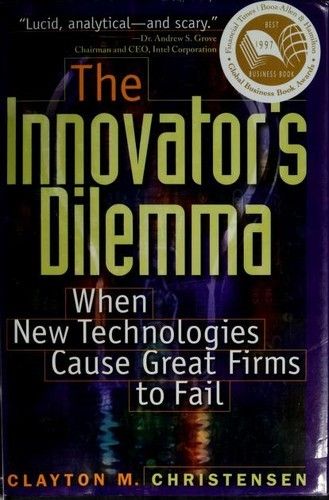
The Innovator's Dilemma, by Clayton M. Christensen, asks a simple question: why do great companies fail? Not lazy or badly run ones, but admired ones, with smart managers who listen to their customers and invest in new technology. Christensen, born in Salt Lake City in 1952, worked as a consultant and ran a small ceramics company before his doctorate at Harvard, where he became a full professor in a record six years. He first described his idea in a Harvard Business Review article in 1995, and the book came out in 1997. It won the Global Business Book Award that year, and The Economist later called it one of the six most important business books ever written.
Its central claim is uncomfortable: doing everything right, listening to your best customers and chasing the best margins, can be exactly what sinks a company. Christensen builds the case on disk drives, which a friend told him were the fruit flies of business because companies there are born, grow and die so fast. He adds stories from steel mills, mechanical diggers, Honda motorcycles and discount stores.
This is an independent written summary of the main ideas, in our own words, based on the Road MBA episode. We're not affiliated with the author or publisher, and nothing replaces reading the book.
Sustaining technologies make a good product better for the customers you already have: more capacity, more speed. Disruptive technologies start out worse: smaller, simpler, slower, often cheaper, good enough only for a small new group of customers. Of one hundred and sixteen new technologies in the disk drive industry, one hundred and eleven were sustaining, and in every one the existing leaders also led the new wave. The other five were disruptive, with no new science in them at all, and not one industry leader stayed on top after they arrived.
Early in 1985, Seagate engineers built working prototypes of a smaller three and a half inch drive. Its best customers, desktop computer makers like IBM, wanted forty or sixty megabytes. The small drive held twenty and cost more per megabyte, so executives canceled it. Two years later Conner Peripherals sold small drives to a market that barely existed when Seagate asked: portable computers. Seagate only shipped its own in 1988, mostly to desktop makers.
The first hydraulic diggers sat on farm tractors and could not reach or lift like the big cable shovels contractors used. They were sold to builders digging narrow trenches for new houses. The leader, Bucyrus Erie, launched a half hydraulic machine in 1951 and pitched it to its usual contractors, who didn't want it. Of thirty cable shovel makers, only four survived the move to hydraulics.
A project your best customers don't want will lose every budget fight, as it should in a normal week. Good management itself pushes the disruptive idea aside.
A company with billions in sales needs hundreds of millions in new sales to grow. A new market worth a few million is a rounding error, even if it is the future.
No research can tell you how big a market will be before anyone has bought the product. Honda's story shows it: the market it found was not the one it planned for.
An organization's processes and values, what it counts as a good project, a good margin or a good customer, are built for the old business. And technology often improves faster than customers need. When the old product is more than good enough, the cheaper, simpler one starts to win.
Christensen's answer is not to try harder inside the main business. Hand the new thing to a separate, small organization sized to its market, where a small win feels big. Sell to the customers who actually want it, and plan for learning, not execution: assume your forecast is wrong, spend a little and find out fast. Kresge built Kmart as its own operation and turned itself into it. Woolworth's discount chain, Woolco, was never really separated from its high margin stores, and it failed.
In 1959 Honda sent three employees to Los Angeles to sell big motorcycles to Americans. The big bikes leaked oil on the highway, and repairs nearly sank the company. To blow off steam, the man in charge, Kihachiro Kawashima, rode his little fifty c c Super Cub in the hills east of Los Angeles, and people began asking where to buy one. The real market was small bikes for fun, off the road. Steel tells the same story. In the 1960s small mills melted scrap in electric furnaces into poor steel fit only for rebar, the worst business in steel, and the big companies were relieved to drop it. By 1980 the small mills had about ninety percent of rebar, then moved to bars, rods and angle iron, then structural beams. In 1995 Bethlehem Steel closed its last plant making them. At every step, giving up the bottom looked like the smart decision.
The one idea to keep: doing what your best customers ask is how you win today, and it can be exactly how you lose tomorrow, so keep one eye on the people at the bottom who want something simpler. The Road MBA episode tells these stories in full.
Your first day is free, no card. Then all 30 for $29, one time.