
Written summary
Rob Fitzpatrick · Day 13 of 30
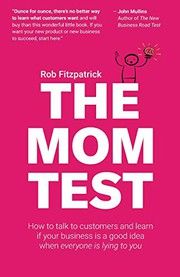
The Mom Test, by Rob Fitzpatrick, is a short handbook on how to talk to customers and find out whether your idea is any good, when everyone around you is being polite. Fitzpatrick went through Y Combinator in the summer of 2007 and describes himself as a programmer who was pushed into a customer facing role at his first company. That company had big name customers and still failed after about four years. In a podcast interview, he tied a lot of that to building on compliments and promises instead of real facts.
The book, published in 2013, is the handbook he wished he'd had. The author says you can read it in about two hours, and it's used at universities like Harvard and University College London. The title comes from its opening story: a young founder pitches his mom a 40 dollar cookbook app for the iPad. She says it sounds amazing. He quits his job, puts his savings into the app, and nobody buys it, not even his mom. She didn't lie because she's a bad person. She lied because she loves him.
This is an independent written summary of the main ideas, in our own words, based on the Road MBA episode. We're not affiliated with the author or publisher, and nothing replaces reading the book.
When you tell people your idea, they don't want to hurt your feelings, they can see you care, and saying something nice costs them nothing. So you collect what feels like proof, and it's really just politeness.
The Mom Test is a set of three simple rules for asking questions that even your mom can't lie to you about.
Deflect compliments and go back to facts about their life. Anchor fluff: if someone says "I always do this," ask "When was the last time?" Dig beneath feature requests. When a customer asks "Are you going to add sync to Excel?", ask why they want it, what it would change for them, and how they handle it now. Sometimes you find a painful, expensive workaround, and that's real information. Sometimes it doesn't really matter.
A good question is one whose answer could change your plans, or even kill your idea. If none of your questions could do that, they're probably not worth asking. Learn to love bad news. It gets you closer to the truth.
If you're building a fitness app and jump straight to questions about the gym, people will happily talk about the gym. Ask first about their biggest problems in general. If they say work, money and family, and health isn't even on the list, that's a warning sign. They may agree that fitness matters and still never spend a cent on it.
A formal interview makes everyone stiff. A relaxed chat over coffee, or even five minutes at an event, can tell you whether a problem is real. And if the person thinks you're selling, they put up their guard, and you stop learning.
A meeting can feel great and still go nowhere. The book calls this a zombie lead: lots of friendly meetings, no progress. The fix is to ask for a clear next step and give the other person a real chance to say yes or no. The test is whether they are giving up something they value. Fitzpatrick names three currencies: time (a trial or a longer meeting), reputation (an introduction to their boss or a testimonial) and money (a deposit or a letter of intent). A compliment costs nothing. A commitment costs something. And a clear no is learning too.
If your group is too broad, you get mixed signals. Slice your audience until you know exactly who you're talking to and where to find them: ten conversations with the same kind of customer teach you more than one conversation each with ten different kinds. Before every conversation, write down the three big things you want to learn. Afterwards, write down what they said in their exact words, and update what you believe.
In the better version, the son never mentions his idea. He asks what his mom uses her iPad for, and about the last thing she did on it: she was planning a trip and just searched online. He asks how she finds the apps she has: a section in the Sunday paper, a real clue about how to reach people like her. Her cookbooks? Christmas gifts, never opened. Then, "What's the last cookbook you bought for yourself?" A vegan cookbook, about three months ago, because his father is trying to eat healthier. Without one compliment, he learns that a general cookbook isn't for her, that gifts might be a market, and that even an experienced cook buys something specific when there's a real need.
This idea is easy to understand in ten minutes and harder to do. The first conversations feel awkward, and you'll catch yourself pitching. That's normal: the skill comes from practice. The Road MBA toolkit for this book has a short question card to bring into your next conversation.
The one idea to keep: don't ask people what they think of your idea. Ask about what they actually did, and the truth shows up, even from your mom.
Your first day is free, no card. Then all 30 for $29, one time.