
Written summary
Ryan Holiday · Day 10 of 30
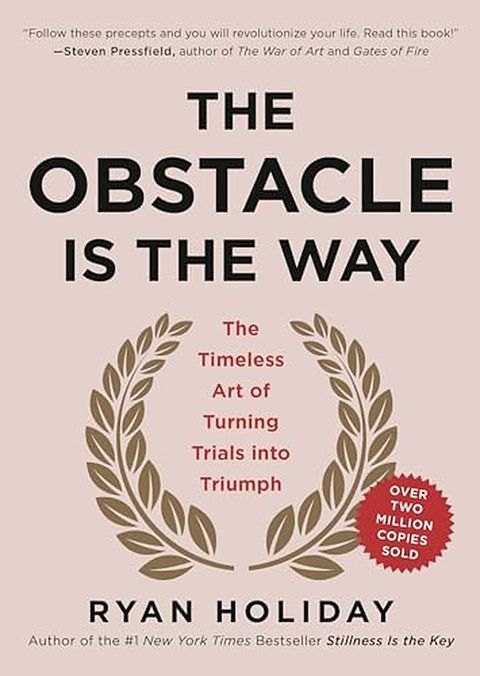
The Obstacle Is the Way, by Ryan Holiday, brings an old philosophy, Stoicism, into modern life. Holiday is an American writer who worked in marketing before he became known for this kind of book, and it came out in 2014. Its title comes from the private journal of the Roman emperor Marcus Aurelius, who wrote notes to himself while away on military campaigns in the years after 170. One became famous. In our own words: whatever blocks the work becomes part of the work, and what stands in the way becomes the way.
Holiday builds the whole book on that line. You can't always choose what happens to you, but you can choose what you do with it. He tells it through stories of people who turned setbacks around: a farmer and a king's boulder, a young John D. Rockefeller in a financial panic, Demosthenes, Amelia Earhart, Abraham Lincoln, and Thomas Edison watching his factory burn.
This is an independent written summary of the main ideas, in our own words, based on the Road MBA episode. We're not affiliated with the author or publisher, and nothing replaces reading the book.
A king puts a huge boulder in the main road into his city and hides to watch. Rich merchants and courtiers complain and go around it or give up. A farmer tries to push it, can't, finds a long branch in the woods and uses it as a lever. Under the rock is a purse of gold and a note: every obstacle carries a chance to improve your situation. Most people saw a rock. One person saw a problem to solve.
Turning an obstacle around, Holiday says, takes perception, action and will. First you see the situation clearly, then you act on it, and then you hold steady with what can't be changed.
When something goes wrong, we add a story in seconds: this is a disaster, this always happens to me, this isn't fair. The facts are one thing; the story is what knocks us down. Holiday borrows from the Japanese swordsman Miyamoto Musashi, who separated two ways of looking. One eye observes what is actually there. The other perceives, adding fear, drama and judgment. Train the first eye.
In 1857, a financial panic hit America. Rockefeller, eighteen and a bookkeeper in Cleveland, watched people panic and lose everything, stayed calm, and studied what was happening. Holiday argues the lesson shaped how he invested for life. What is always in your control: your judgments, attitude, effort, decisions and will. Put your energy there, not into everything else.
Holiday separates context, how a problem looks against the bigger picture of your life, from framing, the meaning you choose to give it. In the Second World War, the German blitzkrieg looked unstoppable. Dwight Eisenhower and the Allied commanders saw that an army racing deep into enemy ground stretches itself thin and can be cut off and surrounded. Same facts, different frame. Ask what this obstacle makes possible that wasn't possible before.
Demosthenes, the great speaker of ancient Athens, was a weak, sickly boy with a speech problem people laughed at. He practiced with pebbles in his mouth, spoke into the wind and while running uphill, and shut himself away to study. The obstacle became his training. Amelia Earhart was told she was second choice for a historic Atlantic flight, and that the men would be paid and she would not. She said yes anyway. Waiting for perfect conditions means waiting forever.
People like Ulysses Grant and Edison attacked a problem from one angle, then another, until something gave. From sport comes the process: don't stare at the scoreboard, do the next play well, then the next. A huge goal becomes one manageable task done right, right now. When something fails, treat it as information. Startups launch a simple first version on purpose to learn what customers really want.
Some obstacles can't be moved. Will is the inner strength no one outside can take. Holiday describes three Stoic practices: imagine in advance what could go wrong so setbacks don't surprise you; accept what you can't change, and even learn to love it as part of your path; and remember life is short, which makes small annoyances look small. Abraham Lincoln struggled with deep depression for most of his life and turned that suffering into patience and compassion when the country needed both.
In December 1914, fire spread through Edison's factory complex in West Orange, New Jersey. Thirteen buildings were gone by the end of the night, with years of work, records and equipment, about one and a half million dollars of damage. Edison was sixty seven. By the accounts of what happened next, he stayed calm, even optimistic, and instead of patching the old plant he ordered everything rebuilt with the newest equipment. His company was making records again by January. He saw the facts without panic, acted at once, and accepted what couldn't be undone.
The one idea to keep: the obstacle in front of you is not in the way of the work, it is the work. See it as it is, act on what you control, and accept what you can't change.
Your first day is free, no card. Then all 30 for $29, one time.