
Written summary
Morgan Housel · Day 22 of 30
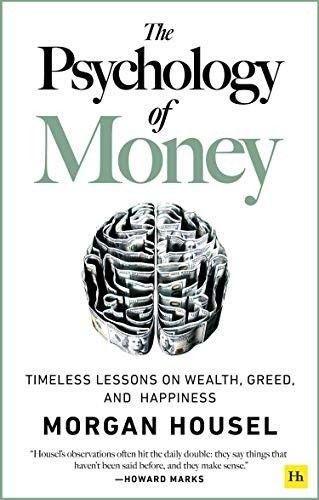
The Psychology of Money, by Morgan Housel, is a book about why smart people still make poor choices with money. Housel is a partner at Collaborative Fund and a two time winner of the Best in Business award from the Society of American Business Editors and Writers. In 2018 he wrote a long blog post with the same title. It spread so fast that he turned it into a book, which came out in 2020, built as nineteen short stories. According to its publisher, it has sold more than ten million copies.
Its central claim fits in one line: doing well with money has little to do with how smart you are, and a lot to do with how you behave. We treat money like physics, with formulas and rules. Housel says it is closer to psychology. People make money decisions at the dinner table, with their history, their ego and their fears all mixed in. The book makes its case with real lives: a gas station attendant from Vermont, a Wall Street executive, a young Bill Gates and his best friend, and Warren Buffett.
This is an independent written summary of the main ideas, in our own words, based on the Road MBA episode. We're not affiliated with the author or publisher, and nothing replaces reading the book.
Your own experience with money is a tiny slice of what has happened in the world, but it shapes most of how you think the world works. Housel gives an example from the American stock market. If you were born in 1970, the market grew almost ten times, after inflation, during your teens and twenties. If you were born in 1950, it went basically nowhere in those same years. Two people, separated only by their birth year, grow up with completely different ideas about whether investing works. Neither one is crazy. When someone's money choice looks silly to you, first ask what they lived through.
In 1968, Lakeside School in Seattle was one of the very few high schools in the world with a computer. Bill Gates was a student there, and he has said that without Lakeside there would have been no Microsoft. That is luck. His best friend there was Kent Evans, by Gates's own account the best student in the class. Kent died in a mountaineering accident before he finished high school. That is risk. Same school, same talent, very different outcomes. The humble lesson: be careful who you praise and who you look down on.
Warren Buffett is one of the best investors who ever lived. Housel points out that, when the book was written, Buffett had a net worth of about 84.5 billion dollars, and about 81.5 billion of it came after his sixty fifth birthday. His skill is investing. His secret is time: he started as a kid and never stopped. So the real question is not how to get the highest return. It is how to get good returns you can stick with for the longest time.
Getting rich takes risk. Staying rich takes the opposite: humility, some fear, and the understanding that what you made can be taken away. For Housel the most important thing is survival. Don't get wiped out, and stay in the game long enough for compounding to work. That is why he loves room for error: some cash you don't touch, and a plan that still works if things go worse than you expect.
When you see someone driving a beautiful car, you rarely think the driver is impressive. You picture yourself in that car. The people we want to impress with our things are not really looking at us. And here is the part most of us get wrong: rich is what you see, like the car, the house or the watch. Wealth is what you don't see. It is the car not bought and the money not spent, still there to give you options later.
Housel's advice on building wealth is simple and a little uncomfortable: save, and you don't need a specific goal to do it, because life will surprise you. The easiest way to save more is not always to earn more. It is to want a little less. Raise your humility, and your savings go up.
For Housel, the best thing money can buy is the ability to wake up and say, I can do what I want today. Not a bigger house, but freedom. Even a few months of savings gives you some of it: the power to leave a bad job or wait for a better offer.
A plan that looks perfect on paper but makes you panic when the market drops is a bad plan. A plan that is a little less efficient but lets you sleep at night is one you will actually keep, and keeping it is the whole game.
In June 2014, Ronald Read died in Brattleboro, Vermont, at ninety two. He pumped gas and fixed cars for about twenty five years, then swept floors part time at a JCPenney store. Yet his will left almost eight million dollars, six million of it to the local hospital and library. Richard Fuscone, Harvard educated and a former vice chairman of Merrill Lynch's Latin America division, retired in his forties. After the financial crisis he stood before a bankruptcy judge, fighting to keep a house of nearly twenty thousand square feet with a mortgage of 66,000 dollars a month. Read saved what he could, bought solid dividend paying companies he understood, and held them for decades. Fuscone's heavy borrowing left him no room for error. The janitor won because he behaved better, not because he knew more.
The one idea to keep: wealth is what you don't see. Save without needing a reason, leave room for error, and give it time. The Road MBA episode tells these stories in full.
Your first day is free, no card. Then all 30 for $29, one time.