
Written summary
Joe Navarro · Day 4 of 30
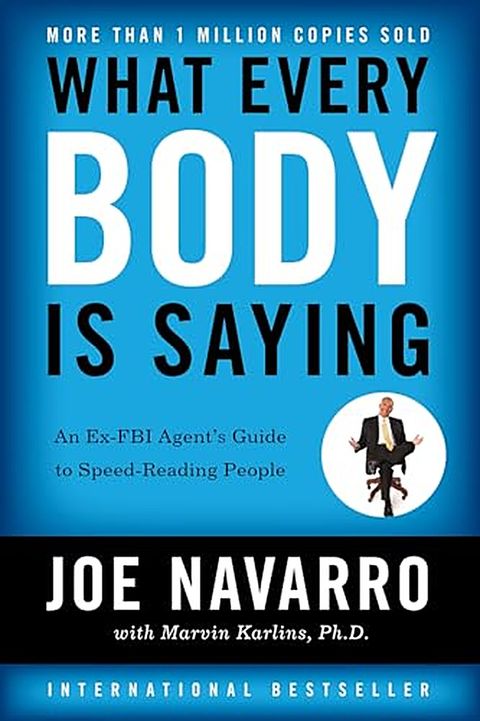
What Every BODY Is Saying, by Joe Navarro with Marvin Karlins, is a guide to reading body language from a man who did it for a living. Navarro was eight when his family fled Cuba for the United States, and he didn't speak English, so he watched faces, hands and the way people stood. That habit became a career: twenty five years as an FBI special agent, much of it chasing spies, and thousands of interviews. The central idea is simple. Your body is talking all the time, and most of it you don't control.
The book draws on real investigative cases, including a Cold War espionage interview built around thirty two index cards and a search for a fugitive whose mother kept saying he wasn't there. Around them, Navarro gives practical rules you can use in a meeting, a negotiation or a first date.
This is an independent written summary of the main ideas, in our own words, based on the Road MBA episode. We're not affiliated with the author or publisher, and nothing replaces reading the book.
Navarro asks you to drop the idea that the thinking brain runs the show. Underneath sits an older system, the limbic brain, which reacts first and without permission. Its three moves come in this order: freeze, flight, fight. Freeze comes first because for millions of years the animal that stood still was the one the predator missed. Today it looks like someone going very still after a hard question. Flight is leaning back, turning away, or putting a bag or coffee cup between you. Fight is rarely a punch: it's the raised voice, the hard stare, the step too close.
Right after stress hits, the body tries to calm itself. Rubbing the neck, touching the face, licking the lips, blowing out a long breath, running the palms down the thighs, playing with a necklace or tie. A baby sucks its thumb; adults have grown up versions. On their own these don't mean someone is lying. They mean something just made the person uncomfortable. The question is always: what happened right before it?
A former soldier under investigation for espionage admitted his own part but would not name others. The agent showed him thirty two cards, each with the name of a fellow soldier who'd had access to the secrets, asked only for comments, and watched his eyes. On two cards, the eyebrows lifted for an instant in recognition, then the eyes narrowed and the pupils got smaller. Two days later the agent returned with those two men's files, and the soldier admitted both were involved. People won't always tell you what they know, but discomfort leaks out the moment the topic comes up.
We learn to control our faces as children and smile at people we don't like all day. The most honest part of the body, Navarro says, is the farthest from the head. At a party, someone smiles as you approach, but one foot turns toward the door, then the other. Feet point where we want to be. If they point at the exit, wrap it up. If they turn toward you, you've been invited in. Feet also leak good news: happy feet bounce under the table while the face stays calm.
When we feel confident or happy we rise on our toes, our thumbs point up and our chin lifts. When we feel low, the shoulders drop, the head goes down and the thumbs disappear into pockets. Comfort opens us up and pulls us toward things. Discomfort closes us and pulls us away.
We lean toward people and ideas we like, turn our chest away from what we don't, and shield our belly with a pillow, a laptop or crossed arms. Confident people use their hands in the open; the steeple, fingertips pressed together, shows certainty. Hidden hands, wringing hands or tucked thumbs say the opposite. And when something bothers us, the lips press together until they almost disappear.
Research keeps finding that most people, police officers included, are no better than chance at spotting deception, and even the best barely get six out of ten. There is no single sign of lying. Looking away doesn't mean lying; plenty of honest people look away when they think. So Navarro hunts for discomfort instead, which is easier to read and tells you where the problem is.
Two investigators asked a woman about her fugitive son. Calmly, she said she hadn't seen him in nine months. When they asked if he could be hiding in the house, she said no, and her hand rose to cover the dip at the base of her neck, just above the breastbone, which Navarro describes as a classic sign of feeling threatened. They asked about the house twice more. Each time she said no, and each time her hand returned to her neck. They asked politely to look around, and found her son hiding in a closet. Her words said no three times. Her hand said yes three times.
The one idea to keep: words are what people decide to tell you, the body is what they can't help telling you. The Road MBA episode tells these stories in about ten minutes.
Your first day is free, no card. Then all 30 for $29, one time.